Wednesday, October 18, 2006

Two new friends...

...with a new house!

ペテちゃんとペチェちゃん、楽しんでね ^_^

Saturday, October 14, 2006

Belly Dance


Belly dance exhibition @ 第24回 江東区民まつり、木場公園。


頑張れ!

People are Strange...


Maybe there is a reason, and the 100yen coin is there for some real purpose. Still, it's undoubtedly strange ^_^

People are Strange
The Doors

People are strange when you're a stranger
Faces look ugly when you're alone
Women seem wicked when you're unwanted
Streets are uneven when you're down

When you're strange
Faces come out of the rain
When you're strange
No one remembers your name
When you're strange
When you're strange
When you're strange

Tina Turner...


...seeee, a Tina Tarnere de noartri

Friday, October 13, 2006

Monday, October 9, 2006

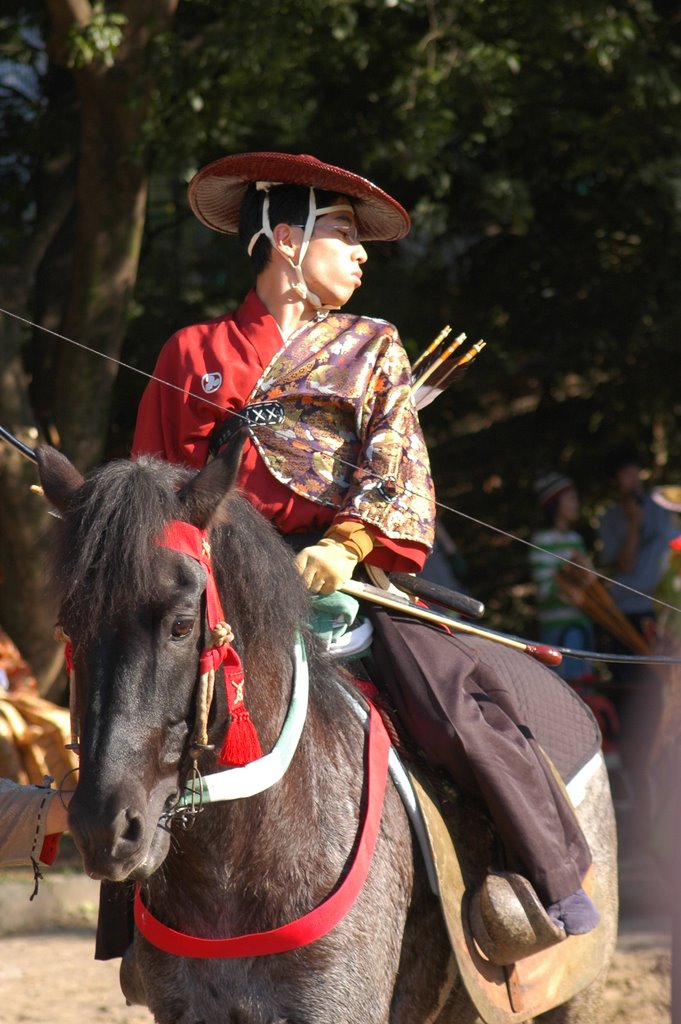
Takadanobaba Yabusame (高田馬場流鏑馬) 

Yabusame (流鏑馬) is spectacular rite of mounted archery performed by riders on horseback dressed in the hunting garb of samurai. While speeding along at full gallop, the archers release the reins and fire arrows at three targets. The rite is carried out to ask for bountiful harvests and peace in the world.
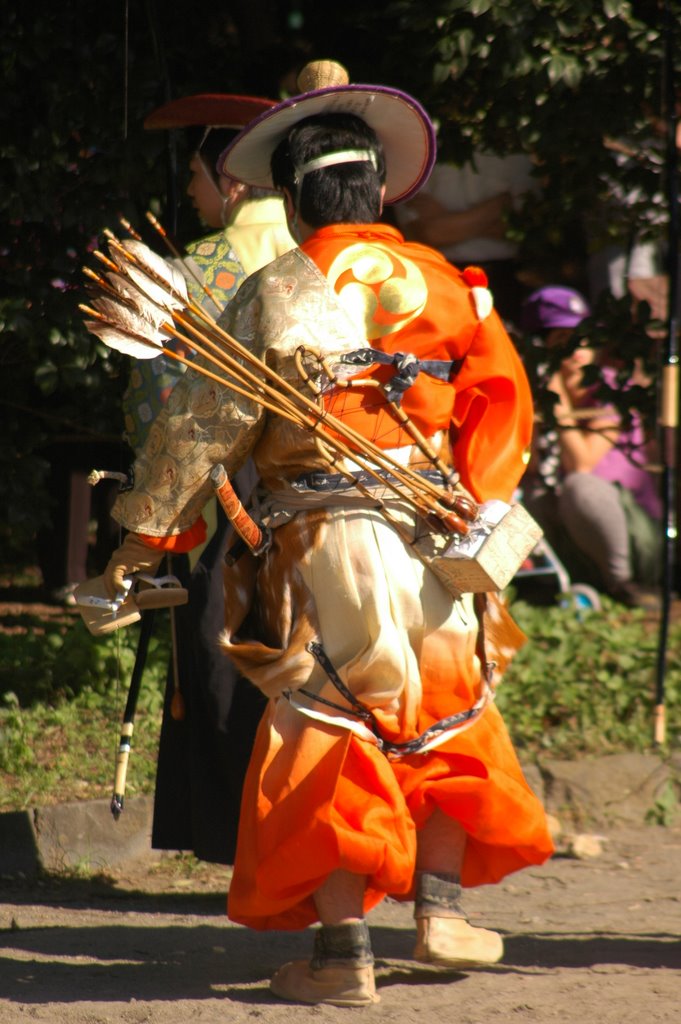
Yabusame originated in the 6th century. To keep the domestic and external affairs of the state from falling into disorder, and to ask for the peace, the emperor prayed at a shrine and mounted on a horse, shot at three targets. In the Heian Period (794-1192) the event flourished as a court ritual.

The Kamakura Period (1192-1338) marked the start of samurai rule in Japan. When government functions were transferred to Kamakura (present day Kamakura City in Kanagawa Prefecture) in the end of the 12th century, the Yabusame rite was performed as the coral Tsurugaoka Hachiman Shrine, which would became an annual official ceremony. After this, the rite spread to the whole country and was widely performed.
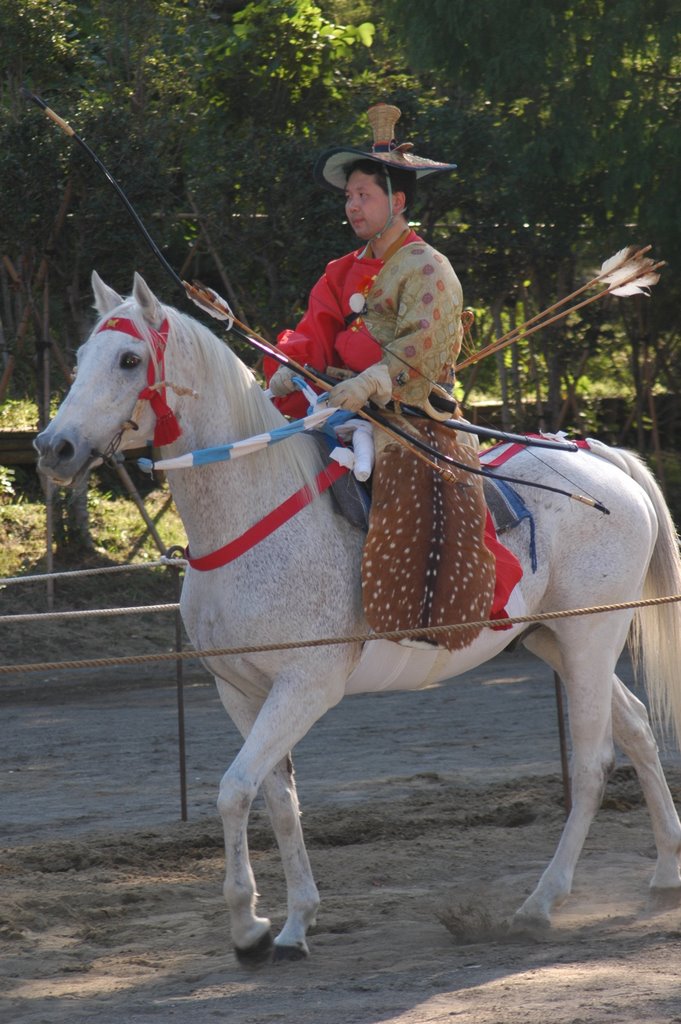


The Yabusame rite, after being in full flourish in the Kamakura Period, temporarily faded, but since the 18th century it has been making a comeback and has survived up to the present day.

These days, in several different styles, the rite is carried out at locations all over the country. Among these the ancient tradition of performing the rite at Tsurugaoka Hachiman Shrine in Kamakura and the newer way of performing the revived rite at Takadanobaba in Tokyo (in these pictures) are particularly well known.

First of all, at the sound of a drum, the archers and their attendants line up at the front of the shrine. According to tradition, all movements are proceeded at the signal of drum beats and motion of a fan. Three targets, each a square of hinoki (Japanese cypress) wood measuring 54.5 cm (about 22 in.) along each edge, are set up at intervals beside an approximately 218 m (about 240 yd.) track. In the rite, the mounted archers release the reins and, while riding at full gallop, try to hit all three targets.
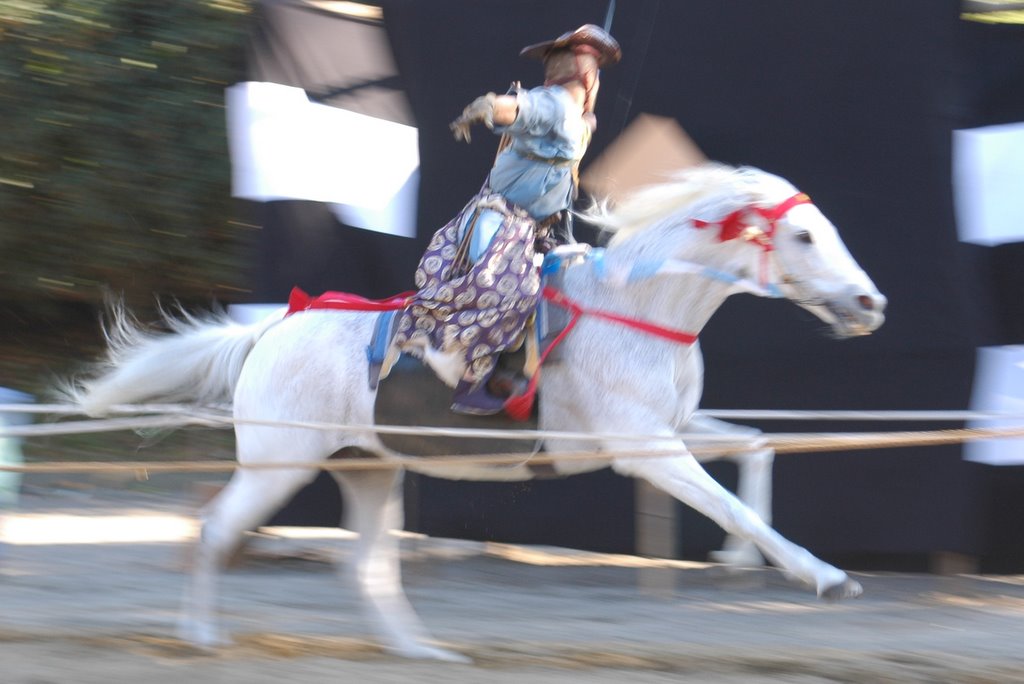

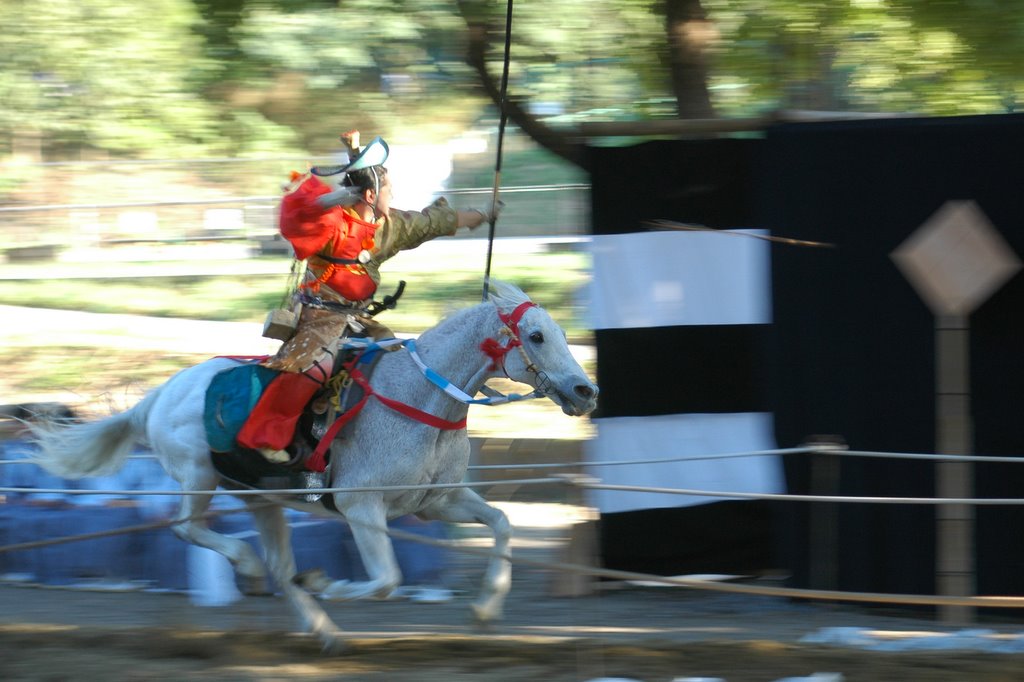
Let the game begin! ^_^


Sunday, October 8, 2006

Gooooooooooood morning Fuji-san


富士山おはよぉぉぉぉぉぉぉぉぉぉぉぉぉぉう! (^_^ )/

Yoyogi park


A place always full of nice surprises ^_^

[This picture has been also published on corriere.it]

Saturday, October 7, 2006

Bob Brozman in Concert


What an incredible Live Performance!

What an Energy!


What a Music!


Bob, thank you so much for sharing with us your music and your art.


Thanks to you, the world is a better place to live in.

Friday, September 15, 2006

桃太郎 - Momotaro

Once upon a time, in the country of Okayama, there lived an old man and an old woman. The old man went everyday into the mountains to cut wood, while his wife would go to the river to wash clothes. One day, while the old woman was down at the river washing clothes, a big peach came floating down the river! It looked so delicious, she decided to take it home for her and her husband to eat. When the old man came back to their home, the old woman cut the peach open, and to their surprise, there was a small boy inside! They decided to call him Momotaro (桃太郎, which can be roughly translated as 'peach boy').
 The old couple raised Momotaro to be big and strong. One day, he decided to go and defeat the ogres living on Ogre Island that were pillaging the land. The old woman fixed him some delicious millet dumplings, known as kibi-dango, for his long journey to the island. On the way, a monkey, a dog, and a pheasant joined him, giving them a dumpling each in return for their help in fighting the ogres.
Upon reaching the Ogre Island, Momotaro and his companions found that the gate was locked to the Ogre's fort. The pheasant flew inside, and grabbed a key to let the others in. Once inside, they fought the evil ogres. The pheasant pecked their eyes, the dog bit their legs and the monkey jumped on their backs, clawing at the beasts. Finally, the ogres cried for mercy! They gave the strong Momotaro all of their treasure, and he returned to his village triumphantly. Momotaro and the old couple lived happily ever after.

Saturday, August 26, 2006

Starry starry night in Umea


I've always been fascinated by the sky spinning around the Polar Star.
Beautiful, isn't it?

Friday, August 25, 2006

People in Umea

Sweden is considered to be a very safe country, but it really seems that this girl wanted to be sure that nobody would have been able to ride on her bike without her to know ;-)

Wednesday, August 16, 2006

Kusatsu (草津)

Kusatsu (草津), in Gunma prefecture (群馬県), has been selected by the Japanese Ministry of the Environment as one of the top 100 scenic spot of peculiar smell (かおり風景100選).


Yubatake (湯畑), the "field of hot water," gushes some 5,000 liters every minute. It is not only the largest hot springs source at Kusatsu (草津), but boasts the highest output of thermal Onsen water anywhere in Japan. The water arrives piping hot from the boiling bowels of the earth, and is cooled through a chain of seven traditional wooden buckets before being sent on to the ryokans of Kusatsu.

Strange but true, no fish inside this pond. I wonder why? ^_^