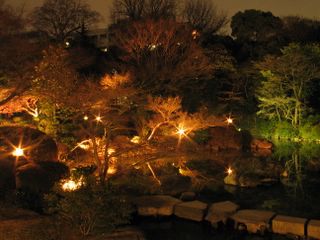
The garden of the Embassy of Italy once belonged to the villa of Ogimori Matsutaka. It is a wonderfully gracious garden with a very important history, like few others in Tokyo. Ultra-centennial trees tell how this garden dates back to in the XVII Century. It was probably arranged by Takuan Osho and it is an authentic, traditional Japanese garden. A small temple on a hillock is still as it was when it was erected. The colours of the garden change wonderfully during all seasons thanks to the azaleas and maple trees. In addition to the birds which dwell in this garden throughout the year, migratory birds rest here over the winter.
During the Meiji era, in the garden of the villa of Ogimori Matsudaira, a very well known historical event took place. Ten of the forty seven ronin who became famous thanks to the kabuki story Chushingura, took their lives in this garden on February 4th 1703. The exact place where they committed the hara-kiri is now underneath the lake and the earth that was dug up was used to make the little mound behind it. On this knoll there stands, since 1939, a small stone monument, inscribed in Italian and Japanese, as a memorial of this event.
After the end of the Tokugawa era, the villa of Ogimori Matsudaira became the home of an important political personality of the Meiji period, Count Masayoshi Matsukata. Matsukata had several sons. One of them, Gan, who grew up in this villa, founded the Jugoginko bank. Kojiro founded the Matsukata Collection and Saburo was one of the founders of mountaineering in Japan. After the II World War, the villa was bestowed to the Jugoginko bank and later became the Embassy of Italy.


